
aiWriter.ai is an AI-powered writing platform designed for generating short stories, novels, romance, fanfiction, and other creative fiction. Unlike a general-purpose AI chatbots (ChatGPT, Claude, etc), aiWriter focuses specifically on storytelling. It offers two dedicated writing models and includes various features to allow the user to create more immersive experiences. I’m sure that all sounds nice and dandy, but this is NSFWLists, so obviously what we’re really interested in is the apps ability to generate quality, uncensored adult content. aiWriter advertises itself as a platform that works for adult writers, but we’ll be the true judge of that.
For this aiWriter AI review, I tested both of its available writing models, Skilled Writer v1 and Deep Writer v2, across several genres, including dark fantasy, mystery, gothic romance, and adult-oriented fiction. I also explored its story continuation features, character memory, editing tools, and subscription plans to see how well the platform performs beyond generating a single story. While some of the results were impressive, we also encountered problems with plot consistency, repetitive writing, and following specific instructions. The goal of this review is to determine whether aiWriter is worth using, how much better its premium writing model performs compared to the free alternative, and whether its uncensored approach makes it a worthwhile choice for adult fiction writers.
Disclosure: NSFWLists received complimentary 90-day access to aiWriter’s Gold plan for testing purposes. This review reflects our independent evaluation of the platform.
What Is aiWriter AI?
aiWriter.ai is a browser-based AI story generator that helps users create fictional content from written prompts. Rather than functioning as a traditional NSFW chatbot, the platform provides a dedicated writing environment where users can generate stories, edit existing text, and continue narratives without repeatedly supplying the entire plot. It supports multiple genres, including fantasy, science fiction, romance, mystery, and adult-oriented fiction.
The platform currently offers two writing models. Skilled Writer v1 is the more accessible option, with unlimited generations available on the free plan. The more advanced model, Deep Writer v2, is able to produce more detailed and polished stories. Users can also create character profiles, define their own custom fictional worlds, and access aiWriter’s library of prebuilt Canon universes. These tools are intended to help maintain consistency when developing longer stories or returning to the same characters across multiple writing sessions.
Another notable feature is aiWriter’s approach to content restrictions. The platform advertises unrestricted content generation across all its subscription plans, including the free tier, and we didn’t find a separate NSFW toggle or adult mode during testing. This makes it particularly relevant for writers interested in mature storytelling, although the actual quality and consistency of the output still depend heavily on which writing model is being used.
Getting Started and User Interface
Getting started with aiWriter is fairly straightforward, especially compared to AI writing platforms that overwhelm users with settings and customization options. The interface is clean and organized around a large writing editor, with a sidebar for accessing saved documents, characters, fictional worlds, and other tools. Most of the screen is dedicated to the story itself, making the platform feel more like a writing application than a traditional AI chatbot. During our testing, we found it easy to move between stories, switch writing models, and generate additional content without having to navigate through multiple menus.
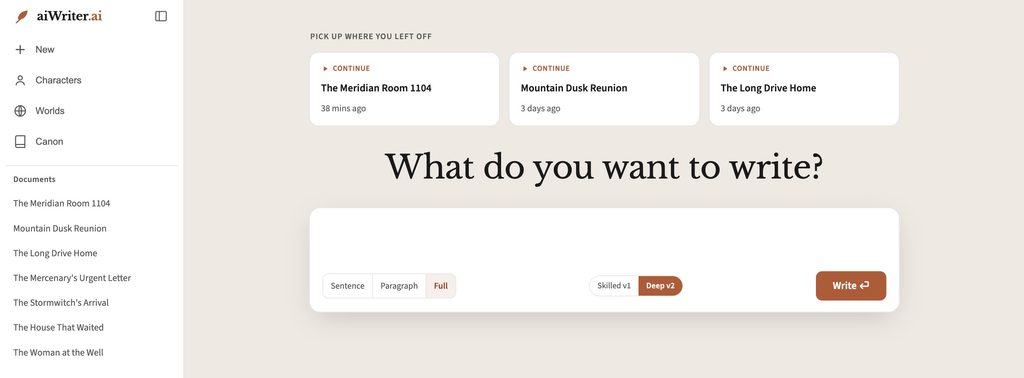
The main editor includes options to save documents, copy text, view writing history, and export completed stories. Users can switch between Skilled Writer v1 and Deep Writer v2 directly from the toolbar, as seen in the screenshot above. I also noticed that my saved stories appear in the left sidebar, which allows me to easily return to previous projects without having to search through an excessively long conversation history. We particularly appreciated this document-based approach because it keeps individual stories separate and makes the platform more practical for anyone working on multiple writing projects.
One of the more useful interface features is the story continuation panel. After generating a story, users can enter instructions describing what should happen next or select one of several suggested directions provided by the platform. For example, during our romance writing test, aiWriter suggested potential developments involving relationship secrets, unexpected interruptions, and changes in the characters’ behavior.
Although users can manually change generated text, we didn’t find specialized editing features that can distinguish aiWriter from a basic text editor. I won’t take any points for that, but it feels like they’re missing out on an opportunity to set themselves further apart from the competition. There also aren’t many visible controls for adjusting writing style or output behavior beyond selecting a model and providing instructions. This simplicity makes aiWriter approachable for beginners, but writers who prefer detailed control over every aspect of the generation process may find it somewhat limiting.
Overall, aiWriter offers a comfortable writing environment that prioritizes generating and continuing stories over complicated configuration. Its clean layout, accessible document library, and convenient continuation tools make it easy to use, while the relatively basic editing capabilities leave room for improvement.
AI Writing Quality: Deep Writer v2 vs. Skilled Writer v1
To evaluate aiWriter’s writing quality, we tested both Skilled Writer v1 and Deep Writer v2 using identical prompts across two genres. My first test prompt was for a 500-word dark fantasy story about a mysterious woman arriving at an isolated village during a thunderstorm, with natural dialogue, atmospheric descriptions, and an unexpected ending. The second prompt was for a 600-word gothic romance about former lovers who reunited in an abandoned mansion, emphasizing emotional tension, believable characters, and a surprise revelation.
These tests revealed clear difference in output quality between the models. Deep Writer v2 consistently produced more polished fiction, while Skilled Writer v1 struggled with generic descriptions, awkward dialogue, and predictable storytelling. However, both models had difficulty following specific instructions, particularly word counts.
Deep Writer v2: Stronger Prose and Character Development
Deep Writer v2 performed well in both genres. In our fantasy test, it generated a mystery involving a woman investigating her sister’s murder in a secluded village. The story developed naturally through dialogue and small details, giving its characters believable motivations without relying too heavily on exposition. Its descriptions were atmospheric, and the conversations generally felt authentic.
The gothic romance test produced similarly strong results. Deep Writer v2 developed the relationship between two former lovers through misunderstandings, emotional conflict, and shared history. Rather than immediately pushing the characters together, it allowed their relationship to unfold through conversation. The writing felt noticeably more mature and natural than what we received from Skilled Writer v1.
However, the model wasn’t exactly flawless. Both stories exceeded their requested word counts, and the romance story introduced a complicated revelation that raised questions about the plot’s logic. Deep Writer v2 appears more capable of producing engaging individual scenes than maintaining perfectly consistent storylines.
Skilled Writer v1: Functional but Less Refined
Skilled Writer v1 handled the same prompts with noticeably weaker results. Its fantasy story followed a mysterious woman named Cwen who discovers a magical curse affecting a village. While the premise was reasonable, the writing relied on familiar fantasy expressions, and the characters lacked depth. Major plot developments also happened conveniently, making the resolution feel rushed.
The gothic romance test exposed similar weaknesses. Skilled Writer v1 generated a reunion between two former lovers, but the dialogue was frequently predictable, and the emotional development felt superficial. The model also used awkward phrasing and occasionally introduced details without sufficient explanation.
Skilled Writer v1 can still produce readable stories, making it useful for casual writing or generating rough drafts. However, its output generally requires more editing than Deep Writer v2, especially when writing dialogue or emotionally complex scenes.
Which aiWriter Model Is Better?
| Category | Skilled Writer v1 | Deep Writer v2 |
|---|---|---|
| Writing quality | 6/10 | 8/10 |
| Dialogue | Often unnatural | More believable |
| Character development | Basic | More detailed |
| Descriptions | Generic at times | Atmospheric |
| Plot consistency | Mixed | Mixed |
| Word count accuracy | Poor | Poor |
Deep Writer v2 is the better choice for users who prioritize writing quality. Its dialogue, descriptions, and character development were consistently stronger across our tests, although it still occasionally struggled with plot consistency and precise instructions. Skilled Writer v1 remains a reasonable free alternative for casual storytelling, but anyone producing longer or more polished fiction will likely benefit from the upgraded model.
NSFW and Uncensored Story Writing
One of aiWriter’s main selling points is its support for unrestricted AI writing, including adult-oriented fiction. Unlike platforms such as DrawNudes, which focus on AI-generated adult images and videos, aiWriter concentrates entirely on written content. It also doesn’t require users to enable a separate NSFW mode or adjust content filters before generating mature stories. The platform advertises unrestricted content across all three subscription plans, including its free tier.
To evaluate its adult writing capabilities, we tested both Deep Writer v2 and Skilled Writer v1 with the same prompt. We requested an 800-word mature romance scene involving two consenting adults in their thirties reuniting at a secluded mountain cabin. The prompt specifically asked for romantic and physical tension, natural dialogue, emotional vulnerability, and a passionate encounter without explicit anatomical descriptions.
How Did Deep Writer v2 Handle NSFW Content?
Deep Writer v2 produced a detailed romance story featuring Elena and Marcus, two former lovers reconnecting after seven years apart. The model developed their relationship through meaningful conversations and gradually introduced physical intimacy, including kissing, undressing, and implied sexual activity. It completed the scene without any apparent content warnings or refusals.
The writing was particularly effective at balancing romantic tension with character development. Rather than rushing into intimacy, the model established the couple’s shared history and emotional hesitation. However, the output remained non-graphic, as requested in our prompt, so this test doesn’t establish how well Deep Writer v2 handles more explicit adult content.
How Did Skilled Writer v1 Compare?
Skilled Writer v1 accepted the same prompt and generated a romantic reunion between two characters named Sarah and James. However, its response was considerably more restrained. Although the characters kissed and expressed romantic feelings, the story ended before reaching the passionate encounter requested in the instructions.
Interestingly, Skilled Writer v1 had previously generated implied sexual intimacy during our gothic romance test. This suggests its inconsistent results may be related to prompt-following rather than deliberate censorship.
Is aiWriter Really Uncensored?
Based on our testing, aiWriter supports mature romantic fiction without requiring users to activate any additional settings. Both models generated adult-oriented material without visible refusals, and unrestricted content is advertised as a feature of every subscription tier.
However, our tests focused on mature romance rather than graphic sexual content, so we can’t independently verify that the platform is completely uncensored. What we can say is that Deep Writer v2 handled our mature writing prompts more consistently, making it the better option for users interested in adult-oriented storytelling.
Story Continuation and Memory
One of aiWriter’s more useful features is its ability to continue existing stories without requiring users to reenter the original text. Instead of generating disconnected scenes, users can provide additional instructions or choose suggested story developments to build on what they’ve already written. During our testing, Deep Writer v2 successfully remembered previous characters, settings, and events when we entered a continuation prompt.
To test this feature, we continued our earlier gothic romance story involving Vivienne and Alaric. Our prompt requested approximately 400 additional words, asking the model to maintain the established personalities, explain a mysterious family connection, and introduce a new clue without contradicting earlier events. Deep Writer v2 picked up directly where the previous story ended, preserving the gothic atmosphere and conversational style without requiring us to paste the original story again.
Unfortunately, the continuation also revealed significant weaknesses in plot consistency. In the original story, Edmund was Vivienne’s husband, but the continuation unexpectedly treated him as her adoptive father. It also introduced conflicting family relationships involving Alaric and Edmund. These contradictions fundamentally changed the characters’ established backstories, demonstrating that remembering previous context doesn’t necessarily mean maintaining narrative accuracy.
The continuation tools themselves are convenient, particularly for writers developing longer stories in multiple sessions. Users can specify what happens next and choose the approximate generation length, making it easier to guide the narrative without starting over. However, our testing suggests that writers should regularly review generated content for inconsistencies, especially when working with complicated relationships or long-running plots.
Overall, aiWriter’s story continuation feature works well from a usability standpoint, but its narrative memory isn’t entirely reliable. It can preserve writing style and general context while still introducing major contradictions, making human oversight important for longer fiction.
Characters, Worlds, and Canon
Beyond basic story generation, aiWriter includes several features designed to help users build fictional characters and settings. The Characters and Worlds sections allow users to create custom profiles using a name and description, while the Canon library provides prebuilt fictional universes for fanfiction and other creative writing projects.
Beyond basic story generation, aiWriter includes several features designed to help users build fictional characters and settings. While the platforms featured in our most realistic AI companion apps rankings focus on creating interactive relationships with virtual characters, aiWriter takes a different approach by using character profiles to maintain consistency throughout written stories. Its Characters and Worlds sections allow users to create custom profiles, while the Canon library provides prebuilt fictional universes for fanfiction and other creative writing projects.
Custom Characters and Character Memory
The Characters feature lets users define a character’s personality, appearance, background, and behavior within a description of up to 4,000 characters. To test it, we created Isabella Voss, a 32-year-old private investigator with several distinctive traits, including a missing husband, an aversion to alcohol, and a habit of tapping her wedding ring when she suspects someone is lying.
We then asked Deep Writer v2 to generate a 500-word mystery involving Isabella investigating a disappearance at a luxury hotel. The model successfully incorporated several characteristics from her profile, including her skeptical personality, direct speaking style, and refusal to drink alcohol. We didn’t need to manually attach the character profile before generating the story.
However, the results weren’t perfect. Isabella failed to demonstrate some of her established habits, and the story contradicted her background by referencing a divorce rather than her missing husband. The feature is convenient, but saved character profiles don’t guarantee that every detail will be remembered accurately.
Custom Worlds and Canon Library
The Worlds feature follows a similar approach, allowing users to create fictional settings through custom names and descriptions. Although straightforward, it provides a place to establish background information about a story’s universe without repeatedly entering those details into prompts. We examined the feature but didn’t conduct a dedicated test of its consistency.
The Canon library takes a different approach by offering prebuilt fictional universes, including Harry Potter and Marvel. Each includes information about its setting and recognizable characters, giving users a starting point for fanfiction. Users can add these universes to their worlds or create editable copies for customization.
Overall, these features make aiWriter more useful than a basic text generator, particularly for writers developing recurring characters or fictional settings. However, our character testing showed that the AI can overlook or contradict saved information, so users working on complex stories should still check their output for consistency.
aiWriter Pricing: Free vs. Plus vs. Gold
aiWriter offers three subscription plans: Free, Plus, and Gold. Unlike some AI writing platforms that restrict adult content to paid subscriptions, aiWriter advertises unrestricted writing across all three tiers. The main differences involve access to Deep Writer v2, story continuation, document limits, and character customization.
Here’s how the plans compare based on the pricing information available during our review.
| Feature | Free | Plus | Gold |
|---|---|---|---|
| Monthly price | $0 | $8.49 | $14.49 |
| Deep Writer v2 | 10 generations/month | 5,000/month | Unlimited* |
| Skilled Writer v1 | Unlimited | Unlimited | Unlimited |
| Story continuation | No | Yes | Yes |
| Documents | 10 | Unlimited | Unlimited |
| Characters and worlds | Not included | 2 | Unlimited |
| Novel writing | Outlines only | 1 book at a time | Unlimited books |
| Unrestricted content | Yes | Yes | Yes |
Unlimited usage is subject to applicable fair-use restrictions.
Users who choose annual billing can get Plus for $84.90 per year or Gold for $144.90 per year, equivalent to approximately $7.08 and $12.08 per month, respectively.
Which aiWriter Plan Is Worth It?
The Free plan is a reasonable starting point for casual users, particularly since it includes unlimited Skilled Writer v1 generations and limited access to Deep Writer v2. However, our testing revealed a noticeable difference in writing quality between the two models, making the free experience less appealing for users who want polished fiction.
Plus offers the best overall value for most writers. At $8.49 per month, it includes 5,000 Deep Writer v2 generations, story continuation, and unlimited documents. That’s a substantial allowance for users regularly generating short stories or experimenting with longer fiction.
Gold costs $14.49 per month and is better suited to heavier users who need unlimited Deep Writer v2 generations, additional character and world profiles, or the ability to work on multiple novels simultaneously. We tested aiWriter using complimentary Gold access, but the writing quality advantage comes from Deep Writer v2, which is also available with Plus.
Overall, aiWriter’s pricing is reasonable for a dedicated AI fiction platform, especially considering the unrestricted content support across all plans. For most users interested in upgrading, Plus appears to offer the strongest balance between features and cost.
aiWriter Pros and Cons
After testing both writing models and exploring the platform’s main features, we found aiWriter to be a capable AI fiction generator with some noticeable limitations. Deep Writer v2 consistently delivered strong creative writing, but issues with story continuity and instruction-following prevent the platform from being a completely reliable solution for longer projects.
Pros
- Strong writing quality with Deep Writer v2: Produces engaging fiction with natural dialogue, descriptive settings, and believable characters.
- Supports mature and adult-oriented writing: No separate NSFW mode is required, and unrestricted content is advertised across all subscription plans.
- Convenient story continuation: Remembers previous story context without requiring users to paste earlier passages.
- Custom characters and worlds: Allows users to create reusable character profiles and fictional settings.
- Generous free plan: Includes unlimited Skilled Writer v1 generations and limited access to Deep Writer v2.
- Multiple export formats: Supports TXT, Word, PDF, and EPUB.
Cons
- Inconsistent plot continuity: Deep Writer v2 occasionally contradicts established character relationships and story events.
- Skilled Writer v1 produces weaker fiction: The free model frequently relies on generic descriptions and unnatural dialogue.
- Poor word count accuracy: Both models sometimes generate significantly more text than requested.
- Basic editing functionality: Lacks the advanced editing and rewriting features found in dedicated writing applications.
- Character memory isn’t completely reliable: Saved character details can be ignored or contradicted during generation.
- Limited generation controls: Users have relatively few options for fine-tuning writing style beyond prompts and model selection.
Final Verdict: Is aiWriter Worth It?
Our Rating: 7.5/10
After extensive hands-on testing, we found aiWriter to be a solid AI story generator, particularly for users interested in creative fiction, romance, and adult-oriented storytelling. Deep Writer v2 was easily the platform’s biggest strength, consistently producing engaging stories with believable dialogue, detailed descriptions, and well-developed characters. Its unrestricted writing approach and straightforward interface also make it an appealing option for NSFW fiction writers.
However, aiWriter isn’t without its weaknesses. We encountered several problems with plot continuity, including characters whose established relationships and backgrounds changed unexpectedly between generations. Both writing models also struggled with word count instructions, while Skilled Writer v1 produced noticeably less polished stories. These issues mean that anyone working on a lengthy novel will still need to review and edit the AI’s output carefully.
At $8.49 per month, the Plus plan offers particularly good value, providing substantial access to Deep Writer v2 without requiring a Gold subscription. Gold is worth considering for heavier users who need more character profiles, unlimited generations, or support for multiple writing projects.
Overall, we recommend aiWriter for casual storytellers, romance writers, and users exploring mature AI-generated fiction. Its premium writing model delivers impressive results for individual scenes and shorter stories, but the occasional continuity problems make it less dependable for complex, long-form projects. If you’re comfortable reviewing and refining the generated text, aiWriter is a worthwhile platform to try.