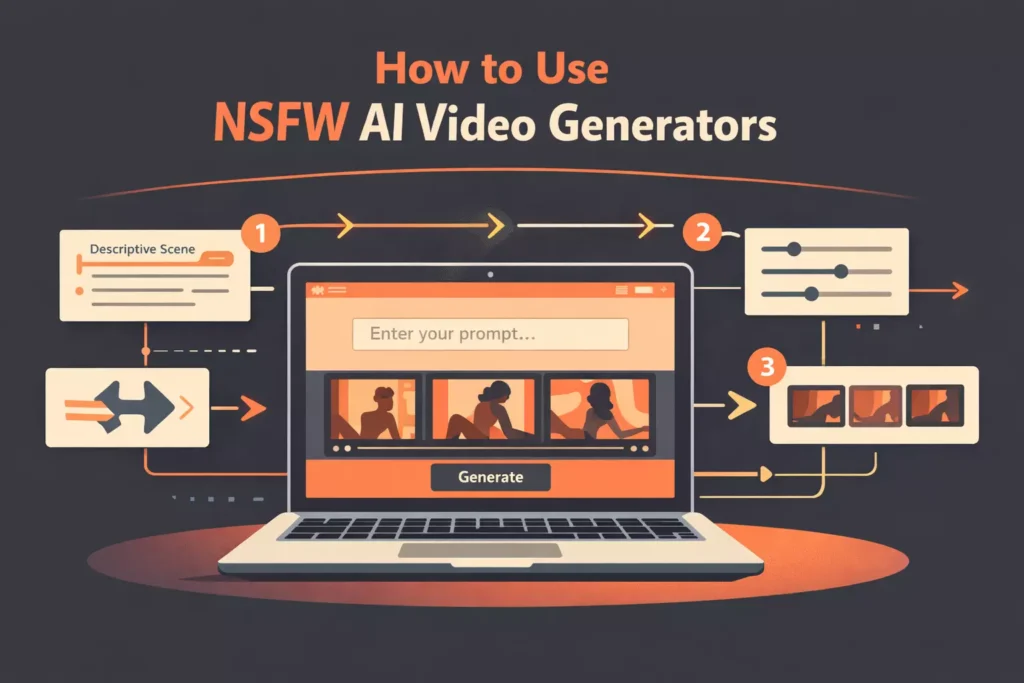
NSFW AI video generators are one of the fastest growing corners of the AI content space, but most people using them do not actually understand what is happening behind the scenes. The output feels simple. You type a prompt, adjust a few settings, and a video appears. Under the hood, though, these systems combine multiple advanced AI technologies working together in a pipeline.
Understanding how NSFW AI video generators work is not just interesting. It also helps you get better results, avoid common mistakes, and choose the right tools for what you are trying to create.
This guide breaks down the full process in a way that actually makes sense, without overcomplicating it.
The Core Idea Behind AI Video Generation
At a high level, NSFW AI video generators do not “record” or “film” anything. They generate video frames from scratch using machine learning models trained on massive datasets. Instead of capturing reality, they predict what each frame should look like based on patterns they have learned.
The process usually starts with a text prompt or an image. The AI then converts that input into a sequence of frames that, when played together, create motion. This is very similar to how AI image generators work, but with an added layer of time and movement.
Step 1: Prompt Understanding
Everything begins with your input.
When you enter a prompt into an NSFW AI video generator, the system first breaks it down into structured data. This includes:
- Objects or subjects
- Actions or motion
- Style or visual tone
- Camera perspective
The model converts your text into numerical representations called embeddings. These embeddings allow the AI to “understand” what you are asking for in a way it can process mathematically.
Better prompts lead to better outputs because the model has clearer instructions to follow.
Step 2: Latent Space Generation
Once the prompt is processed, the AI moves into what is called latent space. This is where most of the actual generation happens.Latent space is a compressed representation of visual data. Instead of working with raw pixels, the AI works with abstract features like shapes, textures, and patterns.
The model begins with random noise and gradually refines it into something meaningful. This process is commonly handled by diffusion models.The AI repeatedly adjusts the noise step by step until it matches the structure described by your prompt.
Step 3: Frame Creation
After generating a base representation, the system starts producing individual frames. Each frame is generated in sequence, but modern models try to maintain consistency across frames. Without this, the video would flicker or change unpredictably.
Key challenges at this stage include:
- Maintaining consistent characters or subjects
- Keeping lighting and style stable
- Ensuring smooth transitions between frames
More advanced NSFW AI video tools use temporal modeling to handle this. That means they do not treat each frame independently. Instead, they consider previous frames when generating the next one.
Step 4: Motion and Interpolation
Creating frames is only part of the process. The AI also needs to simulate motion. This is done through interpolation, where the model fills in the gaps between key frames to create smooth movement.
There are two main approaches:
- Frame-by-frame generation, where every frame is created directly by the model
- Keyframe animation, where the AI generates important frames and fills in the rest
Interpolation helps reduce jitter and makes the final video look more natural.
Step 5: Rendering and Output
Once all frames are generated, the system compiles them into a video file.
At this stage, additional enhancements may be applied:
- Upscaling to improve resolution
- Frame smoothing for better motion quality
- Color correction or style adjustments
The final output is then rendered into a standard video format like MP4.
The Role of Training Data
NSFW AI video generators rely heavily on training data. The model learns patterns from large datasets that include images and videos.
This training process teaches the AI:
- How human motion works
- How lighting behaves
- How different visual styles look
The quality and diversity of the training data directly impact how realistic the generated videos appear. This is also why different platforms produce noticeably different results.
Why Some Tools Look Better Than Others
Not all NSFW AI video generators are equal, and the difference usually comes down to three factors. Model quality is the biggest one. More advanced models have better understanding of motion and consistency.
Compute power also matters. Generating high quality video requires significantly more processing than images.
Finally, optimization plays a role. Some tools are designed for speed, while others focus on realism. If a tool generates videos quickly, it often sacrifices detail or smoothness.
Common Limitations You Should Know
Even the best NSFW AI video generators still have limitations. Consistency is one of the biggest issues. Characters may change slightly between frames, especially in longer videos. Motion can also feel unnatural if the model struggles with complex actions.
Another limitation is length. Most tools are optimized for short clips rather than long videos.
Understanding these limitations helps you set realistic expectations and avoid frustration.
How to Get Better Results
If you want higher quality outputs, you need to work with the system instead of against it.
Start with clear, structured prompts. Avoid vague descriptions and focus on specific details. Keep your scenes simple. Complex prompts increase the chance of errors or inconsistencies.
Experiment with different tools. Each platform has its own strengths, and switching tools can dramatically improve results as you learn how to use NSFW AI video generation tools.
Finally, iterate. Most high quality outputs come from refining prompts over multiple attempts rather than getting it right the first time.
The Future of NSFW AI Video Generators
Th NSFW AI tool space is evolving quickly. New models are improving frame consistency, motion realism, and generation speed. Some tools are already experimenting with real time video generation and longer clips.
As compute becomes cheaper and models become more efficient, the gap between AI generated video and traditional video production will continue to shrink. For content creators and marketers, this opens up entirely new possibilities.
Final Thoughts
NSFW AI video generators are not magic tools. They are complex systems built on diffusion models, temporal consistency, and massive datasets. Once you understand how they work, everything becomes easier. You can write better prompts, choose better tools, and avoid the common mistakes that most beginners make. More importantly, you start to see where the technology is going and how to take advantage of it early.